SurfIO research note
How to get cited by AI: a documented readiness check
No page can claim a reliable route to an AI citation. A better readiness test is whether the answer, author, supporting facts, and rendered experience are all easy for a reader to inspect.
Research object
- Question
- What reader-checkable page requirements appear across four named primary documents when assessing citation readiness?
- Method
- Reviewed four named primary documents, grouped their guidance into four reader-checkable categories, and recorded coverage without inferring citation likelihood.
- Population and denominator
- Four named primary platform documents · 4 documents
- Limitations
- A documented page can still be uncited; the review is not predictive.
Do not promise a citation
The phrase ‘get cited by AI’ can tempt a page into making a claim the evidence cannot carry. The primary documents in this review do not offer a citation formula, and this article does not manufacture one. They do point toward work that is easier for a reader to inspect: useful information, transparent authorship, and page facts that are visible rather than hidden in code. That is a better standard for a publishable page.
This is more than cautious wording. A team that frames the task as a guaranteed outcome will often optimise a proxy such as a keyword count or an opaque score. A team that frames it as reader-checkable quality can review the published page, fix a missing source, and explain the decision to a buyer. The latter is a workflow a real editor can own.
Evidence: Google Search Central AI features guide, Google helpful content guidance
Make the answer inspectable
Start the page with the direct answer to the query, then show how the answer was reached. A reader should be able to identify the author, open the sources, and see which statement each source informs. Google’s helpful-content guidance is useful because it emphasises original, people-first work and clear information about who created the content. That makes a named byline part of the evidence model, not decorative page furniture.
For example, an agency page can say ‘our audit reviews claims, sources, and page implementation’ and then list those inputs in a table. It should not say that the audit produces citations unless it has a defined study supporting that outcome. The difference between those two sentences is the difference between a service description and an unsupported performance promise.
Evidence: Google helpful content guidance, Microsoft AI search guidance
Test visible evidence before markup
A page is not more credible because it has a large JSON-LD block. Google’s structured-data guidance says structured data should represent the visible page. So the editor should first check that the answer, comparison table, author card, and sources are actually present for a reader. Only then is it sensible to test whether the markup describes the same things.
This order catches a practical failure: a draft may have schema describing an organisation, an author, and a service, while the page body offers only a generic sales paragraph. The fix is not to enrich the schema. The fix is to add or narrow the visible explanation until the claim has evidence. The rendered mobile page is part of the same check: a clipped table or missing source link is still missing evidence.
Evidence: Google structured data guidance
Use a repeatable release decision
Treat citation readiness as a small editorial release checklist. Ask whether the page gives a direct answer, names the author, links the evidence, and keeps the visible facts aligned with the implementation. Record which checks passed and which remain open. The value is not the percentage by itself; it is the ability to describe what needs work without pretending to know how a future AI answer will behave.
If one check is missing, hold the page as a draft and fix that class of omission across the batch. This route does exactly that: pages without the full evidence contract stay noindex. That fail-closed rule protects the index from thin pages while leaving an editor a clear path to complete them.
Evidence: Google Search Central AI features guide, Microsoft AI search guidance
Source comparison
| Category | What a reader can check | Editorial implication |
|---|---|---|
| Authorship | A real byline links to background information | Name who is accountable for the explanation |
| Visible facts | Markup describes visible information | Keep every machine-readable claim in the article |
| Accessible answer | The answer is useful to people first | Lead with an answer before the sales pitch |
| Clear information | Content is easy to understand and use | Use concrete language and explain terms |
Units: Documented categories. Denominator: 4 reviewed categories. Exclusions: This does not measure AI citation share.
Visual explanation
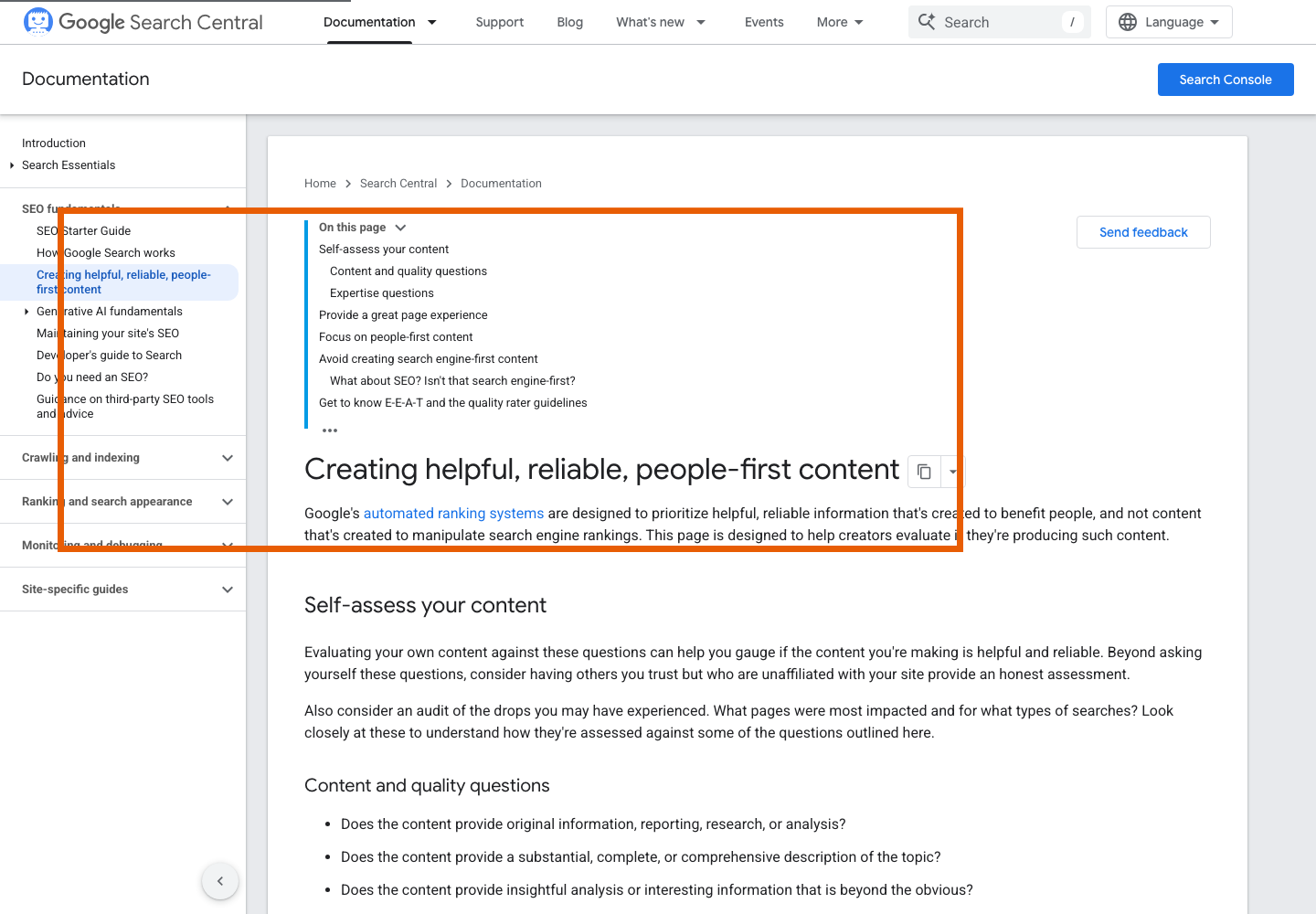
Source: Google helpful content guidance, public documentation capture used for commentary and source identification. · 2026-07-26

Source: SurfIO worked example using the article’s defined four-check audit. · 2026-07-26
Concrete example
A B2B consultancy has a draft called ‘How our AI visibility review works’ with a service claim but no source links or author background.
- Rewrite the opening as a direct description of the review inputs rather than a promise of citations.
- Add the consultant’s byline and link their relevant background, then add named sources beside the recommendations they support.
- Render the page on a phone and confirm that the table and sources remain reachable; compare the visible claims with the structured data.
Decision: The draft remains noindex until all four defined checks are visible and traceable.
Limitation: Four completed checks establish editorial completeness only, not a probability of being cited by an AI system.
Worked calculation
documented checks met / reviewed checks = checklist coverage
- Documented checks met: 3 checks
- Reviewed checks: 4 checks
3 / 4 = 75% checklist coverage
One defined editorial check remains open; the percentage is not a predicted citation rate.
Methodology
SurfIO reviewed four linked primary documents and mapped their guidance to four page-review categories on 26 July 2026.
Limitations: The output is an editorial readiness audit, not an experiment measuring AI answers.
Editorial review
Reviewed by Codex visual QA on 2026-07-26. Executor review of local rendered desktop and 390x844 mobile screenshots, the primary-source capture, source-to-claim references, and non-predictive language. Human editorial approval is not represented by this record.
Passed: explanation depth, evidence integration, concrete example, visual usefulness, mobile review, desktop review.
Sources
- Google Search Central AI features guide · accessed 2026-07-26
- Google helpful content guidance · accessed 2026-07-26
- Google structured data guidance · accessed 2026-07-26
- Microsoft AI search guidance · accessed 2026-07-26
Acesley Chan
SurfIO Founder and AEO Strategy Director
7+ years in digital marketing; HKSTP Ideation Programme
Author background