SurfIO research note
Answer Engine Optimization: a source-backed editorial audit
AEO is an editorial discipline: make one useful claim, show the evidence a reader can inspect, and keep the page release honest about what has not been measured.
Research object
- Question
- Which practical editorial requirements recur across four named primary platform documents relevant to answer engine optimization?
- Method
- Reviewed four named primary documents and recorded whether each gives actionable guidance on useful content, visible factual support, or accessible page information.
- Population and denominator
- Four named primary platform documents · 4 documents
- Limitations
- Documentation describes platform guidance, not a guarantee of traffic, ranking, or AI citation.
Set the right claim before you optimise
Answer engine optimization becomes vague when a draft promises that a page will be cited, surfaced, or ranked. The primary documents in this review do not make that promise. They give publishers a more useful starting point: publish information that helps a person, can be understood on the page, and is maintained as an honest representation of the underlying work. That distinction matters because it changes the job from gaming an unknown output to making a claim that can survive a reader’s scrutiny.
For a service page, the first editorial decision is therefore not which phrase to repeat. It is whether the page answers one question in plain language and states the boundary of the answer. A strong draft can say what the service includes, who it is for, and what evidence supports a result. It should not turn a source review into a prediction about a particular AI product.
Evidence: Google Search Central AI features guide, Google helpful content guidance
Build an answer a reader can trace
A sourceable answer names the person or organisation behind the claim, shows the supporting material, and explains why that material changes the recommendation. Google’s helpful-content guidance is relevant here because it asks publishers to demonstrate first-hand expertise and clear authorship. In practice, that means an unsupported sentence such as ‘our method improves visibility’ needs either a defined observation, a named source, or a narrower claim.
The useful unit is a decision, not a citation list. If a guide recommends adding an author card, the reader should be able to see the card and understand what the author is qualified to explain. If a page cites platform guidance, the source should be linked beside the part of the argument it informs. That makes disagreement possible and keeps the article useful even when a platform changes its presentation.
Evidence: Google helpful content guidance, Microsoft AI search guidance
Keep visible facts and markup together
Structured data is not a substitute for an explanation. Google’s structured-data documentation says that markup should describe the information visible on the page. The practical editorial rule is simple: if a table, author credential, price boundary, or claim is important enough to describe in code, it must also be readable in the article. Readers should not need a crawler to find the substance.
That rule prevents a common AEO failure. A team may add detailed schema while leaving the page itself generic. The result is a mismatch: the machine-readable layer makes a stronger statement than the visible copy can defend. This audit treats that mismatch as a reason to hold the page, not as a technical enhancement. The release check should compare the visible claim with its source before considering metadata complete.
Evidence: Google structured data guidance
Run the release check as an editorial decision
Before release, assign one owner to read the page in the form a visitor receives. Check that the direct answer appears before promotion, that every material statement has a named basis, and that the sources still open. Then check the rendered mobile page: the comparison table must scroll rather than clip, images need descriptive alternative text, and the author information must remain visible. These are experience checks, not a score for an AI system.
The release decision is deliberately conservative. A fully documented page may still never appear in an AI answer, because the documents reviewed here do not establish that outcome. But a page with an untraceable claim or hidden evidence gives both readers and future reviewers less to work with. Holding that page until the evidence is visible is the useful AEO action.
Evidence: Google Search Central AI features guide, Microsoft AI search guidance
Source comparison
| Source | Decision-useful guidance | How it changes the draft |
|---|---|---|
| Google AI features guide | Use search fundamentals for AI features | Start with a reader-useful answer, not an AI-only trick |
| Google helpful content guidance | Show original work, sourcing, and authorship | Give the claim a named owner and traceable support |
| Google structured data guidance | Keep markup aligned with visible page facts | Do not let schema say more than the article says |
| Microsoft AI search guidance | Make answers clear and accessible | Prefer a direct explanation over keyword stuffing |
Units: Named documents. Denominator: 4 reviewed documents. Exclusions: No outcome or ranking metric is reported.
Visual explanation
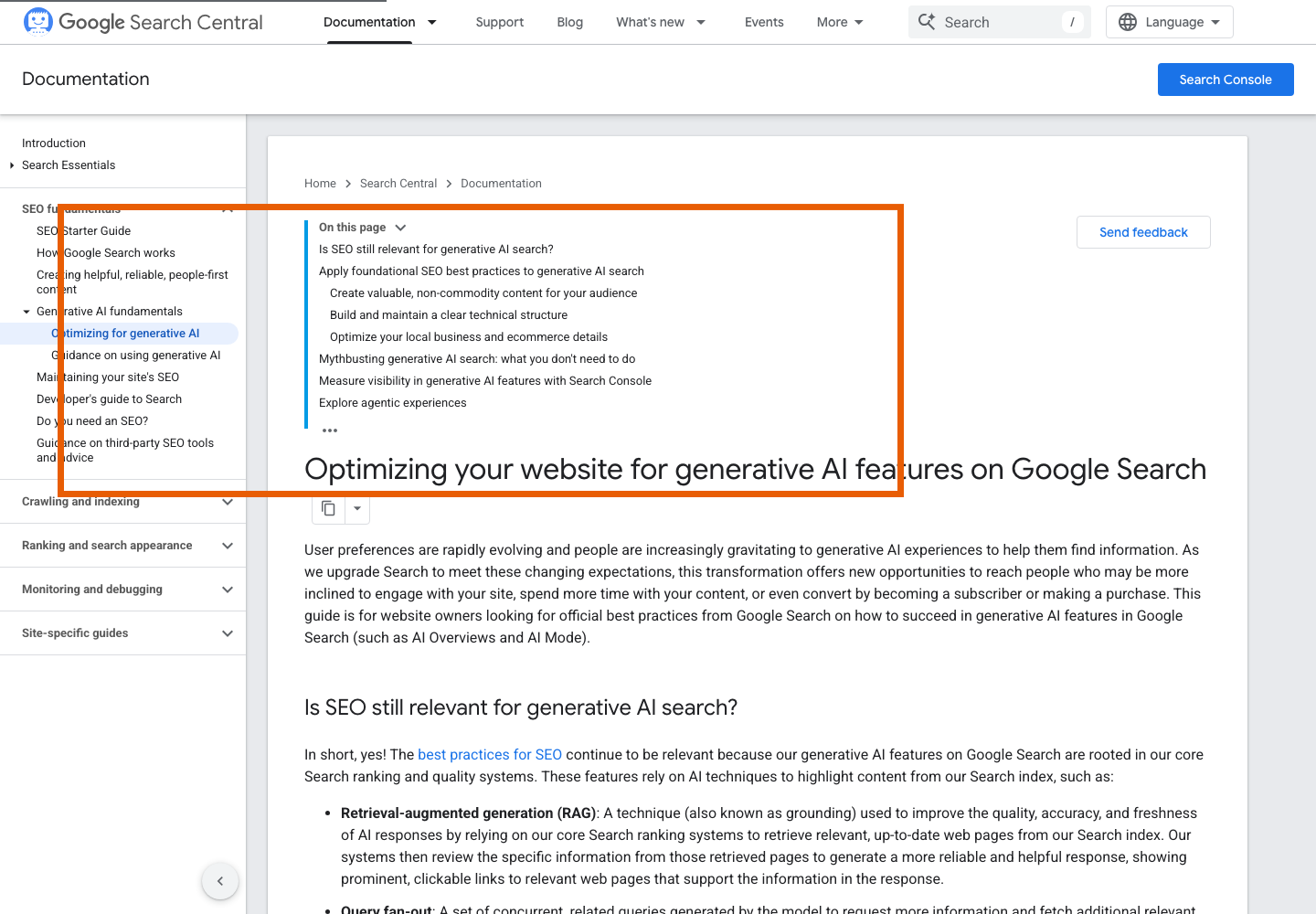
Source: Google Search Central AI features guide, public documentation capture used for commentary and source identification. · 2026-07-26

Source: SurfIO methodology diagram based on the documented review process. · 2026-07-26
Concrete example
A B2B SaaS team wants a page answering ‘What does an AEO content audit include?’ without claiming that the audit guarantees citations.
- Write a two-sentence answer that names the audit inputs: page claims, linked sources, visible evidence, and structured-data alignment.
- Add a byline and link the author background, then put the supporting source beside each material recommendation.
- Compare the rendered table and schema with the visible copy; remove any schema statement the reader cannot verify on the page.
Decision: Publish only after the answer, author, source links, and visible facts agree; otherwise hold the draft as noindex.
Limitation: Completing this example improves auditability only. It does not measure or predict AI citations.
Worked calculation
verified release checks / defined release checks = release-check coverage
- Verified release checks: 4 checks
- Defined release checks: 4 checks
4 / 4 = 100% release-check coverage
The result means the defined editorial checks passed for the example. It is not a traffic, ranking, or citation forecast.
Methodology
SurfIO reviewed four linked primary documents on 26 July 2026, mapped each to an editorial decision, and used those decisions to review the example page.
Limitations: The method is a reproducible document review. It does not test search-engine rankings or answer-engine citations.
Editorial review
Reviewed by Codex visual QA on 2026-07-26. Executor review of local rendered desktop and 390x844 mobile screenshots, source-to-claim references, screenshot attribution, and the concrete example. Human editorial approval is not represented by this record.
Passed: explanation depth, evidence integration, concrete example, visual usefulness, mobile review, desktop review.
Sources
- Google Search Central AI features guide · accessed 2026-07-26
- Google helpful content guidance · accessed 2026-07-26
- Google structured data guidance · accessed 2026-07-26
- Microsoft AI search guidance · accessed 2026-07-26
Acesley Chan
SurfIO Founder and AEO Strategy Director
7+ years in digital marketing; HKSTP Ideation Programme
Author background